855773644-LEED-v5-BD-C-Reference-Guide-Launch-Edition - Page 426
Extracted Content
accurately compare and evaluate similar products, improving their decisions when selecting materials during design.
PATH 1: PROJECT-AVERAGE APPROACH
Projects can earn points by reducing embodied carbon, measured by comparing the project’s total embodied carbon of procured materials to industry average values through an EC3 comparison or similar tool. For industry averages values project teams should use EPA values, the most recent Carbon Leadership Forum (CLF) Material Baselines Report, or similar. If no values are found in these given sources, regionally appropriate industry wide EPD’s are acceptable. Project teams must provide a narrative comparing the impact between the procured materials and the industry averages as well as a justification of the sources used for comparison if they vary from those recommended.
PATH 2: MATERIAL-TYPE APPROACH
This path is also meant to align with state and federal procurement policies, specifically the Federal Buy Clean Act [114], a U.S. federal government initiative that prioritizes the use of locally made, lower-carbon construction materials in federal procurement and federally funded projects to allow flexibility in choosing products to reduce embodied carbon. Project teams will compare their structure, enclosure, and hardscape targeted material types to product-specific Type III EPDs to demonstrate that the products they have procured have a lower embodied carbon intensity than typical across the industry.
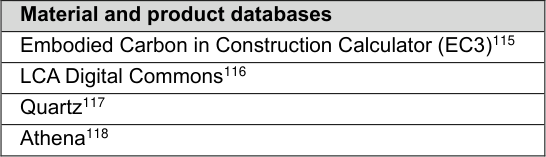
Project teams can research products with EPDs in online databases (see Table 4). In addition to these databases, many manufacturers publish EPDs directly on their website. Industry-specific associations may also have resources available for searching EPDs related to their trade.
Table 4. Resources for finding EPDs
114 “Federal Buy Clean Initiative”, Office of the Federal Chief Sustainability Officer, Council on Environental Quality, (n.d.), accessed April 2, 2025, https://www.sustainability.gov/archive/biden46/buyclean/index.html. 115 “Embodied Carbon in Construction Calculator”, Building Transparency, (n.d.), https://buildingtransparency.org/auth/login. 116 “LCA Digital Commons”, Federal LCA Commons, (n.d.), https://www.lcacommons.gov/. 117 “Quartz Countertops”, Pharos, (2025), https://pharos.habitablefuture.org/common-products. 118 “Athena research teams follow common building materials from cradle-to-grave to calculate the environmental effects at each stage in the product’s life cycle”, Athena Sustainable Materials Institute, (2025), https://www.athenasmi.org/our-software-data/lca- databases/.
U.S. Green Building Council LEED v5 Reference Guide for Building Design and Construction, April 2025 Launch Edition 416