Page 014 - new in intelligent and creative ways.
Source section: Section 1 - Introduction to Green Buildings and Communities PDF page: 14 Guide page: 7 OCR quality: high (444 words)
OCR Text
Many of the elements of green building are not new or even unique. Before the widespread availability of
inexpensive fossil fuels for energy use and transportation, builders understood the principles of passive
design, capturing sunlight and wind for natural lighting, heating, and cooling. In many ways, green building
represents a return to simpler, low-tech solutions. At the same time, there are now many high-tech strategies
available to improve the performance of the built environment. Green building is about finding the best
combination of solutions to create built environments that seamlessly integrate the best of the old and the
new in intelligent and creative ways.
The USGBC was formed in 1992, a time when the field was beginning to define itself, to promote and
encourage green building. Amember-based organization, USGBC engages hundreds of thousands of
individuals. The mission of USGBC is “to transform the way buildings and communities are designed, built
and operated, enabling an environmentally and socially responsible, healthy, and prosperous environment
that improves the quality of life.”* USGBC supports achievement of this mission through education
programs, advocacy, research, an extensive network of local chapters, and the LEED green building program.
Soon after it was formed, USGBC began developing LEED for rating and certifying sustainability in the
building industry. Experts identified characteristics and performance levels that contributed to a definition
ofagreen building. The first LEED green
building rating system was launched in —
- In the decade that followed, LEED mY i es
expanded to include systems to address the gi 3 vga » 2
entire life-cycle of the built environment 4 IN
from land-use planning to operations. It now a
provides rating systems for a wide array of . F
building types, such as offices, schools, retail
establishments, homes, and neighborhoods.
The trend toward green building practices in iss.
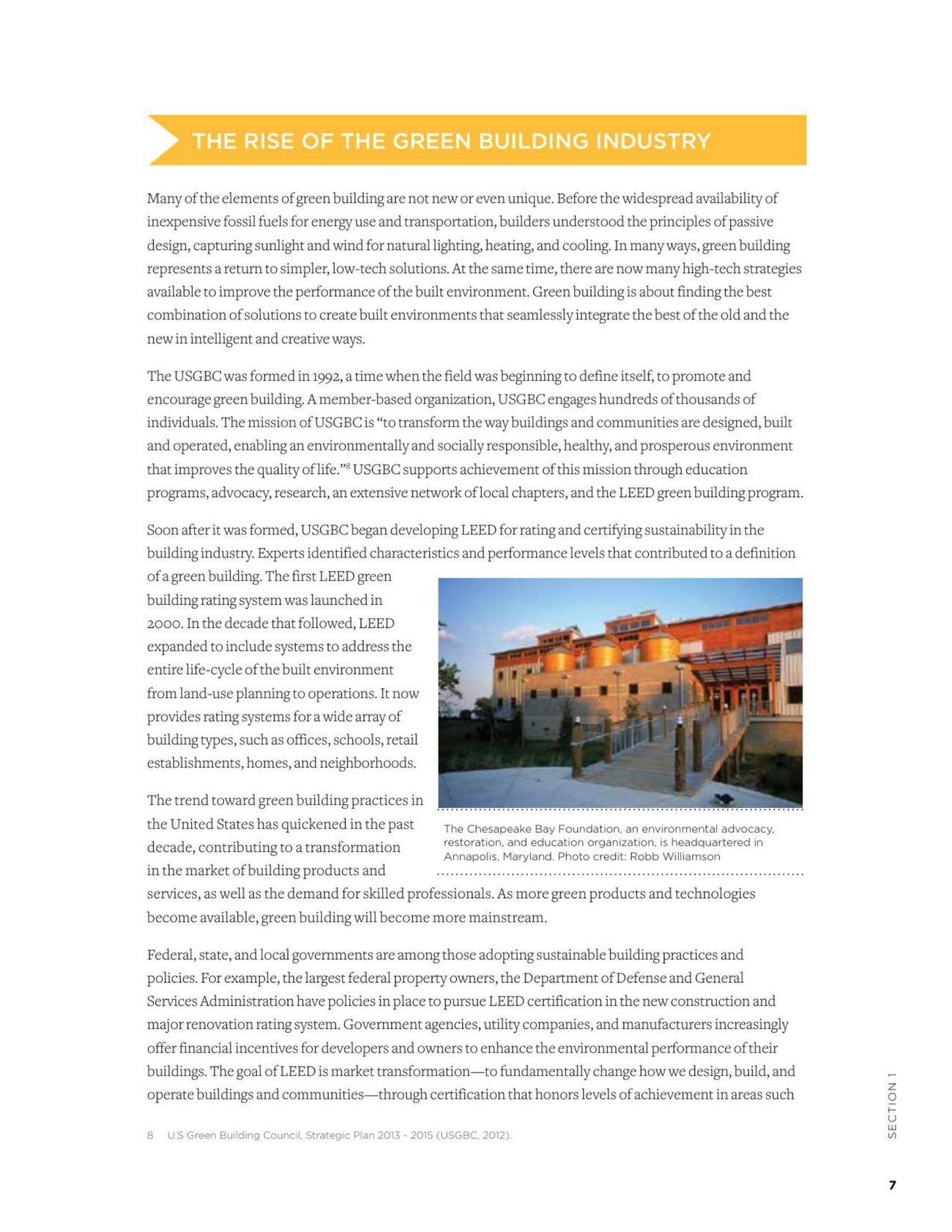
the United States has quickened in the past The Chesapeake Bay Foundation, an environmental advocacy,
in the market of building products and sev ssionase exes ea nEUDELTUANICRRENS aes ease RR REM eNNRNSENES TE
services, as well as the demand for skilled professionals. As more green products and technologies
become available, green building will become more mainstream.
Federal, state, and local governments are among those adopting sustainable building practices and
policies. For example, the largest federal property owners, the Department of Defense and General
Services Administration have policies in place to pursue LEED certification in the new construction and
major renovation rating system. Government agencies, utility companies, and manufacturers increasingly
offer financial incentives for developers and owners to enhance the environmental performance of their
buildings. The goal of LEED is market transformation—to fundamentally change how we design, build, and -
operate buildings and communities—through certification that honors levels of achievement in areas such o
8 U.S Green Building Council, Strategic Plan 2013 - 2015 (USGBC, 2012). a 7