Page 018 - be discussed in Section 4.
Source section: Section 1 - Introduction to Green Buildings and Communities PDF page: 18 Guide page: 11 OCR quality: high (315 words)
OCR Text
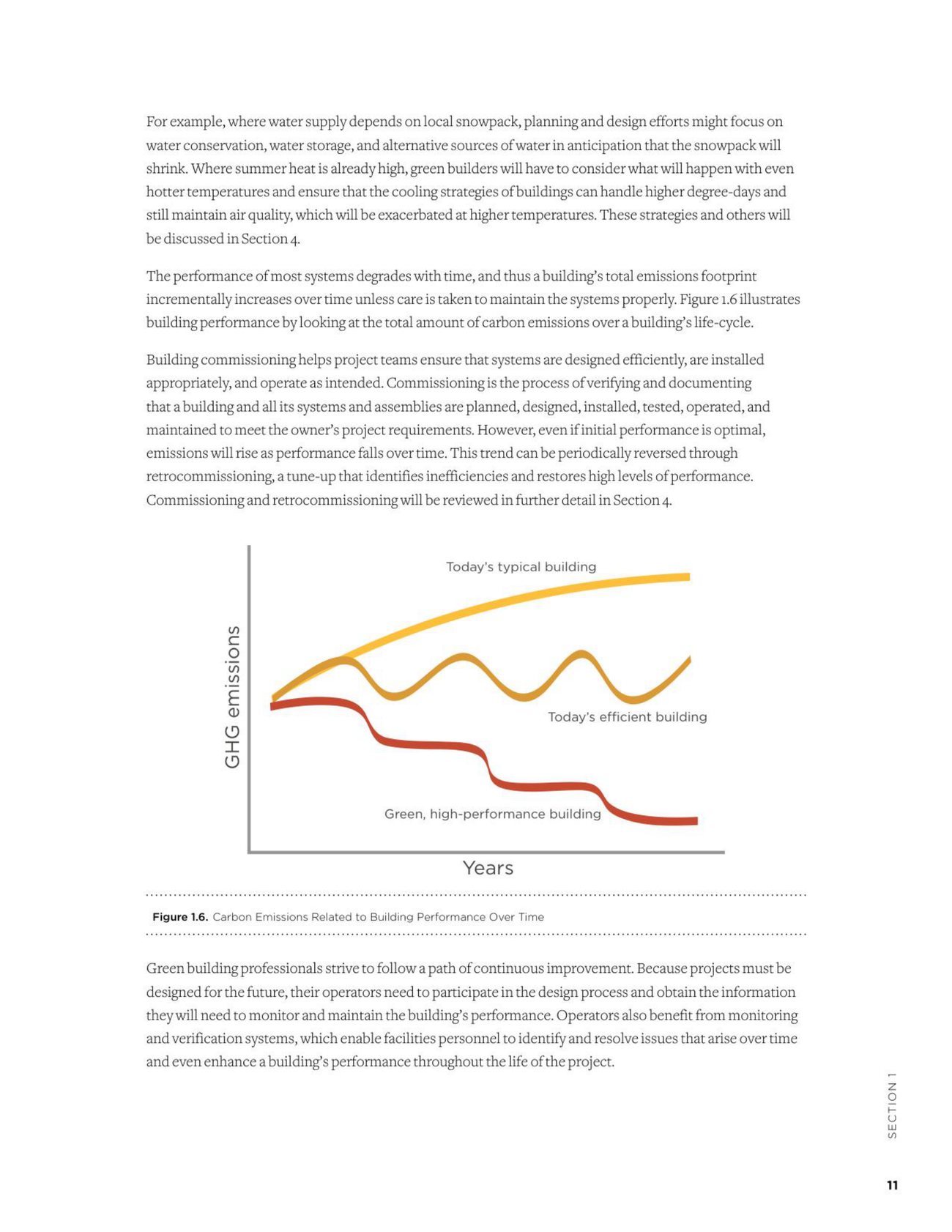
For example, where water supply depends on local snowpack, planning and design efforts might focus on water conservation, water storage, and alternative sources of water in anticipation that the snowpack will shrink. Where summer heat is already high, green builders will have to consider what will happen with even hotter temperatures and ensure that the cooling strategies of buildings can handle higher degree-days and still maintain air quality, which will be exacerbated at higher temperatures. These strategies and others will be discussed in Section 4. The performance of most systems degrades with time, and thus a building’s total emissions footprint incrementally increases over time unless care is taken to maintain the systems properly. Figure 1.6 illustrates building performance by looking at the total amount of carbon emissions over a building’s life-cycle. Building commissioning helps project teams ensure that systems are designed efficiently, are installed appropriately, and operate as intended. Commissioning is the process of verifying and documenting that a building and all its systems and assemblies are planned, designed, installed, tested, operated, and maintained to meet the owner’s project requirements. However, even if initial performance is optimal, emissions will rise as performance falls over time. This trend can be periodically reversed through retrocommissioning, a tune-up that identifies inefficiencies and restores high levels of performance. Commissioning and retrocommissioning will be reviewed in further detail in Section 4. Today’s typical building 7) Cc 2 a B o Today’s efficient building 1Y) =. 1) Green, high-performance building Years Figure 1.6. Carbon Emissions Related to Building Performance Over Time Green building professionals strive to follow a path of continuous improvement. Because projects must be designed for the future, their operators need to participate in the design process and obtain the information they will need to monitor and maintain the building’s performance. Operators also benefit from monitoring and verification systems, which enable facilities personnel to identify and resolve issues that arise over time and even enhance a building’s performance throughout the life of the project. z fe)
) Ww un N