Page 022 - actual average marginal cost of less than 2%.”
Source section: Section 1 - Introduction to Green Buildings and Communities PDF page: 22 Guide page: 15 OCR quality: high (393 words)
OCR Text
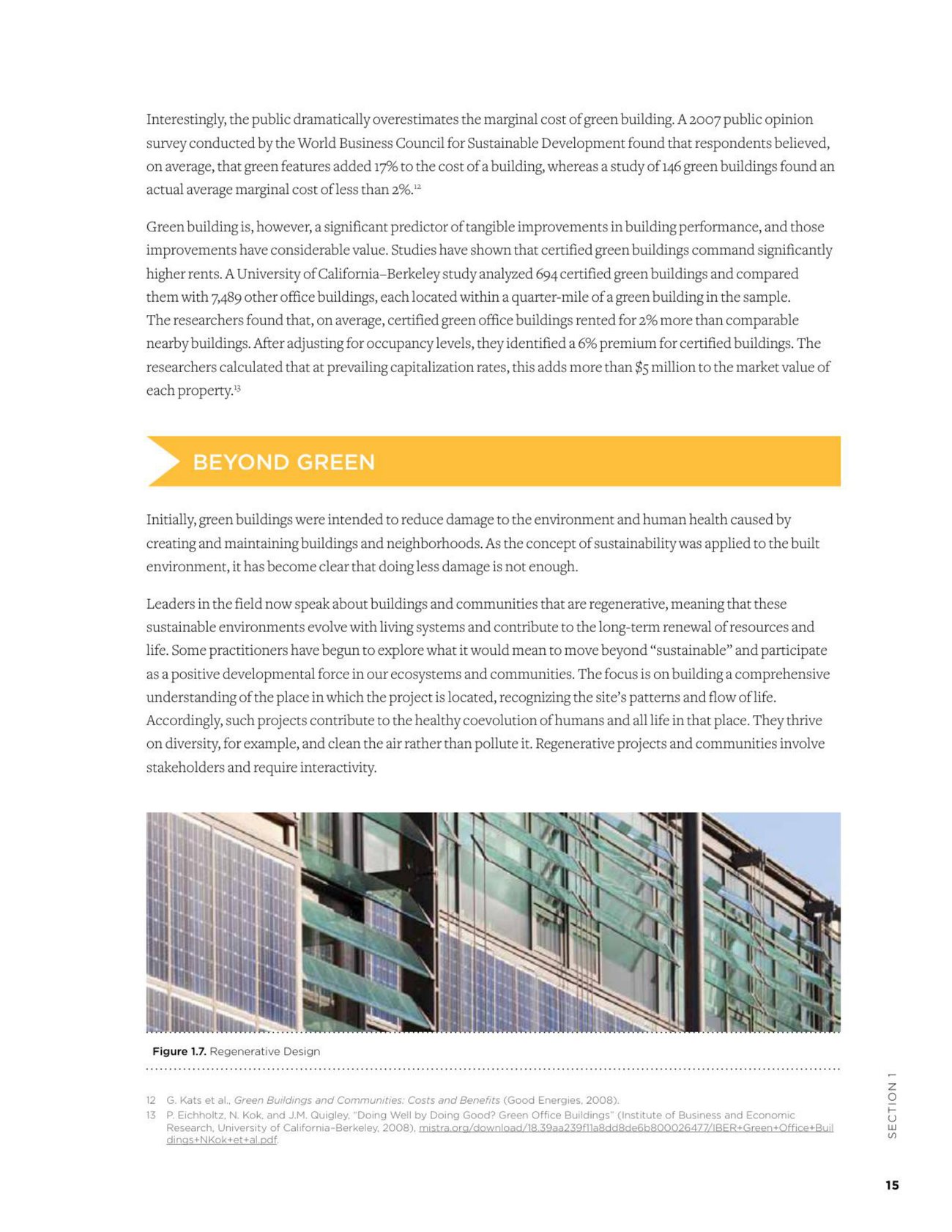
Interestingly, the public dramatically overestimates the marginal cost of green building. A 2007 public opinion survey conducted by the World Business Council for Sustainable Development found that respondents believed, on average, that green features added 17% to the cost of a building, whereas a study of 146 green buildings found an actual average marginal cost of less than 2%.” Green building is, however, a significant predictor of tangible improvements in building performance, and those improvements have considerable value. Studies have shown that certified green buildings command significantly higher rents. A University of California—Berkeley study analyzed 694 certified green buildings and compared them with 7,489 other office buildings, each located within a quarter-mile of a green building in the sample. The researchers found that, on average, certified green office buildings rented for 2% more than comparable nearby buildings. After adjusting for occupancy levels, they identified a 6% premium for certified buildings. The researchers calculated that at prevailing capitalization rates, this adds more than $5 million to the market value of each property.? BEYOND GREEN Initially, green buildings were intended to reduce damage to the environment and human health caused by creating and maintaining buildings and neighborhoods. As the concept of sustainability was applied to the built environment, it has become clear that doing less damage is not enough. Leaders in the field now speak about buildings and communities that are regenerative, meaning that these sustainable environments evolve with living systems and contribute to the long-term renewal of resources and life. Some practitioners have begun to explore what it would mean to move beyond “sustainable” and participate as a positive developmental force in our ecosystems and communities. The focus is on building a comprehensive understanding of the place in which the project is located, recognizing the site’s patterns and flow of life. Accordingly, such projects contribute to the healthy coevolution of humans and all life in that place. They thrive on diversity, for example, and clean the air rather than pollute it. Regenerative projects and communities involve stakeholders and require interactivity. me 7 * 4 Pr wy B ss vf NE { - 7 Mba tie, ra | > f Nt SS ms. a . . | Sy x wD) “Sb d we, + ~~ -d Ns | } = SS as Figure 1.7. Regenerative Design z 12 G. Kats et al., Green Buildings and Communities: Costs and Benefits (Good Energies, 2008). ° 13. P. Eichholtz, N. Kok, and J.M. Quigley, “Doing Well by Doing Good? Green Office Buildings” (Institute of Business and Economic 5 Research, University of California~-Berkeley, 2008), mistra.ora/download/18.39aa239flla8dd8de6b800026477/IBER+Green+Office+Buil w dings+NKok+et+al.pdf “ 15