Page 033 - LEVERAGE POINTS
Source section: Section 2 - Sustainable Thinking PDF page: 33 Guide page: 26 OCR quality: high (366 words)
OCR Text
LEVERAGE POINTS Places to Intervene in a System (in increasing order of effectiveness): 12. Constant, parameters, numbers (such as subsidies, taxes, standards) Tl. The sizes of buffers and other stabilizing stocks, relative to their flows 10. The structure of material stocks and flows (such as transport networks, population age structures) 9. The lengths of delays, relative to the rate of system change 8. The strength of negative feedback loops, relative to the impacts they are trying to correct against 7. The gain around driving positive feedback loops 6. The structure of information flows (who does and does not have access to what kinds of information) 5. The rules of the system (such as incentives, punishments, constraints) 4. The power to add, change, evolve, or self-organize system structure 3. The goals of the system 2. The mindset or paradigm out of which the system—its goals, structure, rules, delays, parameters—arises
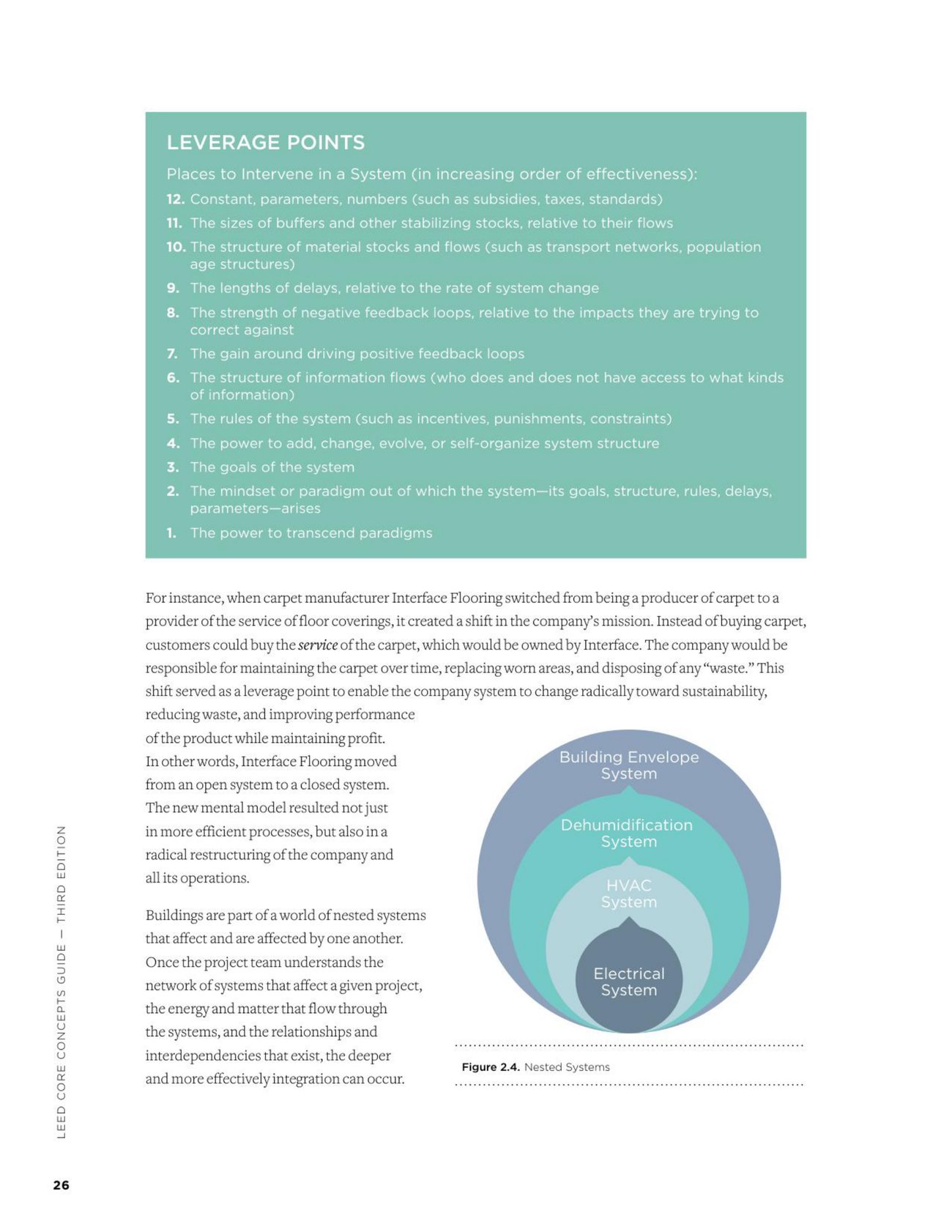
- The power to transcend paradigms For instance, when carpet manufacturer Interface Flooring switched from being a producer of carpet toa provider of the service of floor coverings, it created a shift in the company’s mission. Instead of buying carpet, customers could buy the service of the carpet, which would be owned by Interface. The company would be responsible for maintaining the carpet over time, replacing wom areas, and disposing of any “waste.” This shift served as a leverage point to enable the company system to change radically toward sustainability, reducing waste, and improving performance of the product while maintaining profit. Inother words, Interface Flooring moved Building Envelope System from an open system to a closed system. The new mental model resulted not just Z in more efficient processes, but also ina Deh ries Coy E radical restructuring of the company and ; 4 all its operations. HVAC = System A Buildings are part of a world of nested systems i a I that affect and are affected by one another. 4 +4 s Once the project team understands the i ’ ; cy . . ; Electrical o network of systems that affect a given project, 1 System Je a the energy and matter that flow through Xx 4 the systems, and the relationships and . = 3 . : : ETOP EOC COT OT STE rr Terror ere e) interdependencies that exist, the deeper w a i” ” Figure 2.4. Nested Systems and more effectively integration can occur. SS OA NW ESENRS OH RASEAUWET TETRA RUSS SHER VET ENR VISAS CONES SONVEES re) a Ww Ww ad 26