Page 035 - demolition or, preferably, reuse.
Source section: Section 2 - Sustainable Thinking PDF page: 35 Guide page: 28 OCR quality: high (537 words)
OCR Text
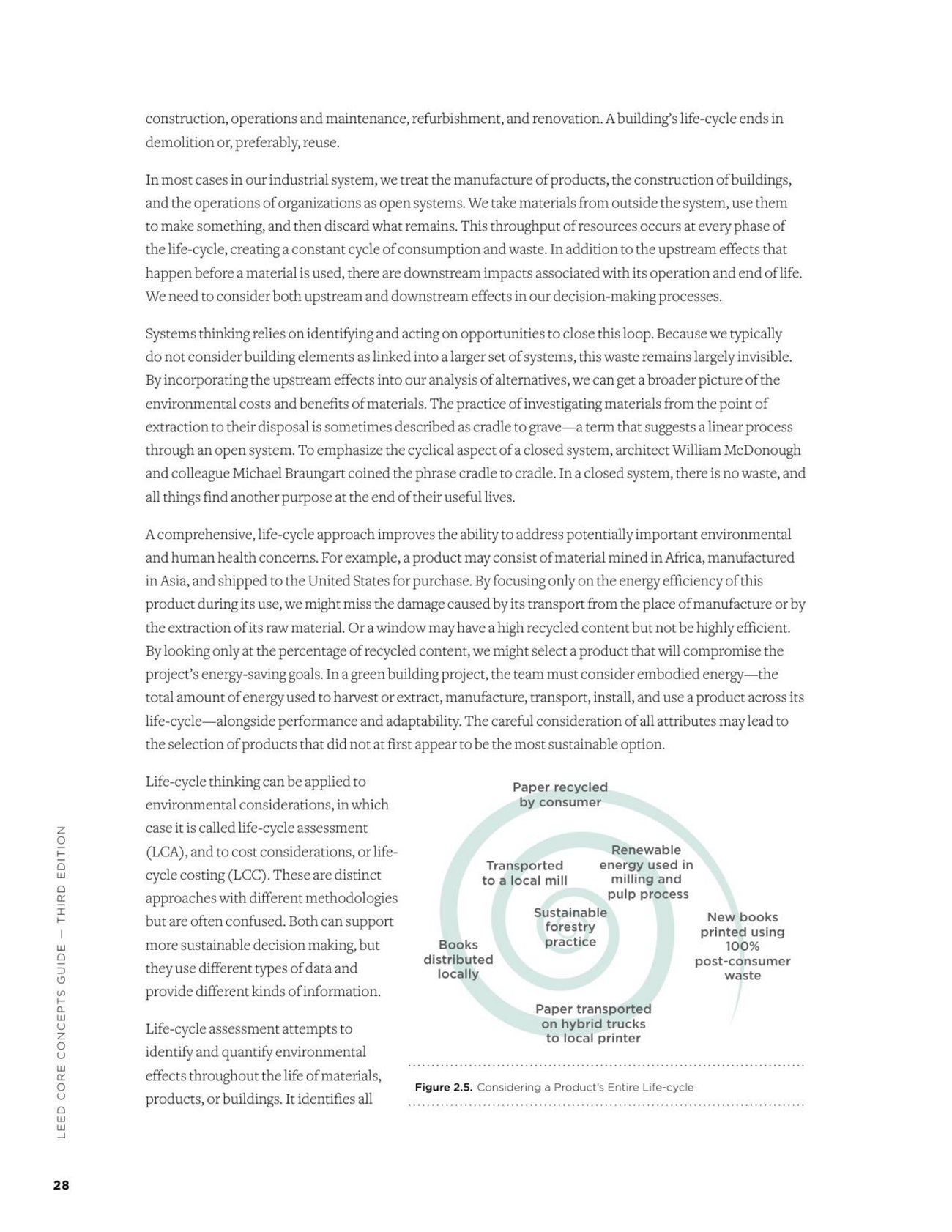
construction, operations and maintenance, refurbishment, and renovation. A building’s life-cycle ends in demolition or, preferably, reuse. In most cases in our industrial system, we treat the manufacture of products, the construction of buildings, and the operations of organizations as open systems. We take materials from outside the system, use them to make something, and then discard what remains. This throughput of resources occurs at every phase of the life-cycle, creating a constant cycle of consumption and waste. In addition to the upstream effects that happen before a material is used, there are downstream impacts associated with its operation and end of life. We need to consider both upstream and downstream effects in our decision-making processes. Systems thinking relies on identifying and acting on opportunities to close this loop. Because we typically do not consider building elements as linked into a larger set of systems, this waste remains largely invisible. By incorporating the upstream effects into our analysis of alternatives, we can get a broader picture of the environmental costs and benefits of materials. The practice of investigating materials from the point of extraction to their disposal is sometimes described as cradle to grave—a term that suggests a linear process through an open system. To emphasize the cyclical aspect of a closed system, architect William McDonough and colleague Michael Braungart coined the phrase cradle to cradle. In a closed system, there is no waste, and all things find another purpose at the end of their useful lives. Acomprehensive, life-cycle approach improves the ability to address potentially important environmental and human health concerns. For example, a product may consist of material mined in Africa, manufactured in Asia, and shipped to the United States for purchase. By focusing only on the energy efficiency of this product during its use, we might miss the damage caused by its transport from the place of manufacture or by the extraction of its raw material. Or a window may have a high recycled content but not be highly efficient. By looking only at the percentage of recycled content, we might select a product that will compromise the project’s energy-saving goals. Ina green building project, the team must consider embodied energy—the total amount of energy used to harvest or extract, manufacture, transport, install, and use a product across its life-cycle—alongside performance and adaptability. The careful consideration of all attributes may lead to the selection of products that did not at first appear to be the most sustainable option. Life-cycle thinking can be applied to Paper recycled environmental considerations, in which by consumer
z case it is called life-cycle assessment
o)
-
(LCA), and to cost considerations, or life- Renewable
a , i Transported energy used in
uw cycle costing (LCC). These are distinct tod ice al mill milli land
a =
« approaches with different methodologies pulp process
x= ustainable
E but are often confused. Both can support 7 forest New books
| bate by of printed using
w more sustainable decision making, but Books practice 100%
Qa . distributed post-consumer
2 they use different types of data and locally wakte
v provide different kinds of information.
a Paper transported
u Life-cycle assessment attempts to Sa rcks
3 : ; to local printer
rs) identify and quantify environmental
te effects throughout the life of materials,
ce) 3 . . Figure 2.5. Considering a Product’s Entire Life-cycle
be products, or buildings. It identifies all Be ee ee ee Tero eer ee eee reer
mt
Ww
=a
28