Page 051
Source section: Section 3 - Sustainable Thinking at Work - New Processes for Building Green PDF page: 51 Guide page: 44 OCR quality: high (484 words)
OCR Text
For some projects, it may seem easy to list the alternatives and then decide on the best one. For example, when designing a new waste management program in a town that has only two waste haulers, the choice may seem simple. But even this situation requires a thorough investigation. The team would first collect all the relevant information about the two waste haulers. They might find that one costs less but that the other has a higher recycling diversion rate, the percentage of waste materials diverted from traditional disposal methods and recycled, composted, or reused. One hauler may accept only sorted recyclables, but the team has determined that a commingled program is more appropriate for the project occupants. Choosing between these two based on this information would require revisiting the team goals. But what if the team values both recycling and cost savings? Or what if another goal is to reduce the greenhouse gas emissions associated with solid waste? The team would then have to consider additional information, such as the distance of each waste management facility from the project site, the types and sizes of trucks used for hauling, and their associated emissions factors. There might be other solid waste strategies that the team should consider, such as composting green waste and other organic matter on site or at another location. Each type of disposal for each type of material would have a different greenhouse gas emissions factor, which must be added to the transportation-related emissions.
That example illustrates four important points.
- When systems thinking is applied to sustainable design, it is often necessary to consider information beyond cost. A wide range of tools can help teams evaluate components of a system, including modeling, life-cycle analysis, and life-cycle cost analysis, as well as inventorying. These tools and technologies will be discussed in Section 4.
- Evenifthe system is evaluated using a complex computer model, the best solution may depend on the team’s goals, metrics, and targets, as well as their resources. The alternatives must be analyzed and evaluated against the goals.
¢ Although alternatives are often viewed as an either-or choice, there may be more than two options.
In the waste hauler example, the question is about more than which hauler to select. When deciding between two alternatives, the project team must ask whether there is a third option (ora fourth ora fifth …). The question can spark the creativity needed to find new solutions that lead to sustainability.
- Sometimes other variables, besides goals, targets, and costs, may make certain solutions inappropriate for the site. Sustainable design means finding not only the measures that perform best ina model but also the solutions that will perform best over the life of the project.
E
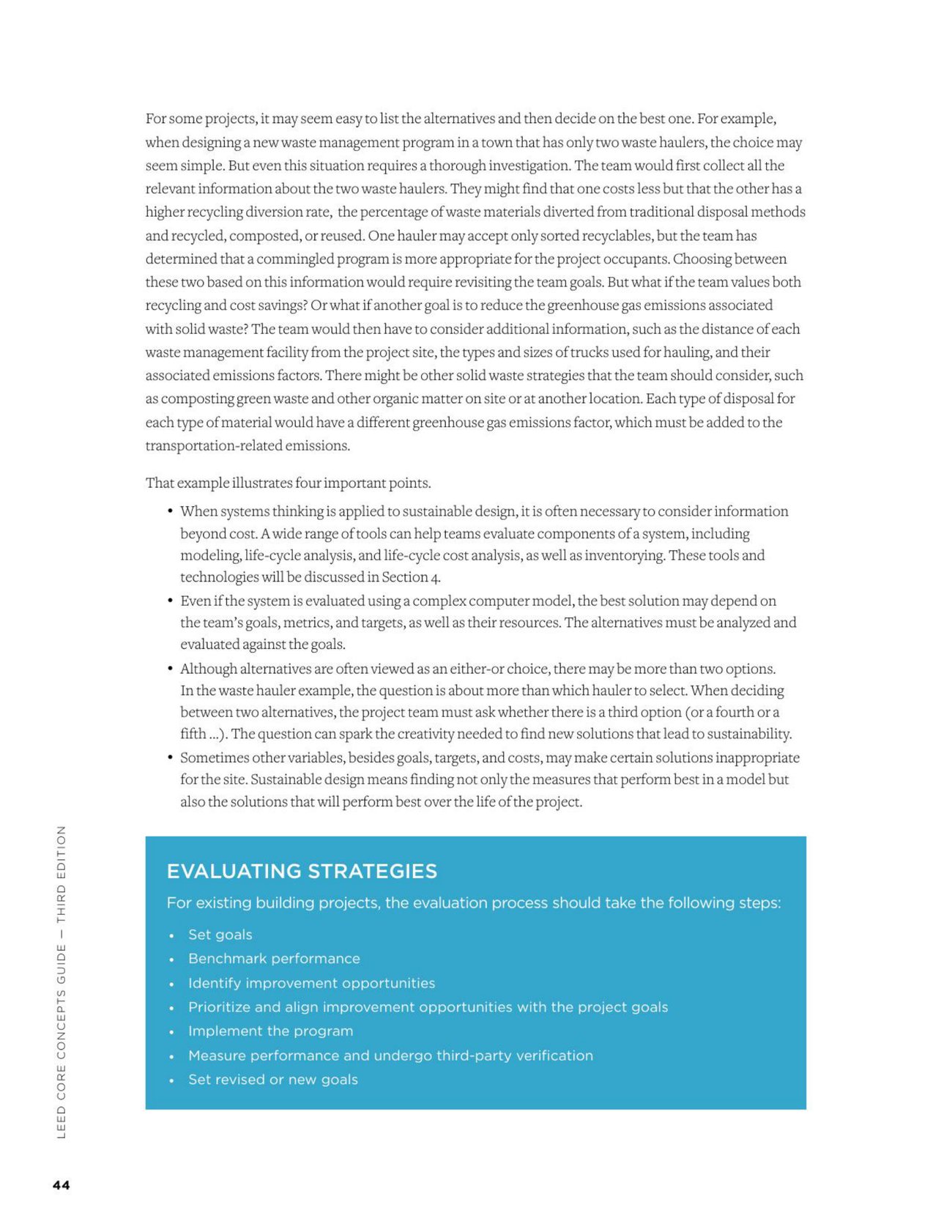
a EVALUATING STRATEGIES
2 For existing building projects, the evaluation process should take the following steps: 1 « Set goals
Ww
a « Benchmark performance
8 - Identify improvement opportunities
a « Prioritize and align improvement opportunities with the project goals g « Implement the program
8 « Measure performance and undergo third-party verification
& « Set revised or new goals
a
4
44