Page 074 - ENERGY EFFICIENCY
Source section: Section 4 - Green Building Core Concepts and Application Strategies PDF page: 74 Guide page: 67 OCR quality: medium (183 words)
OCR Text
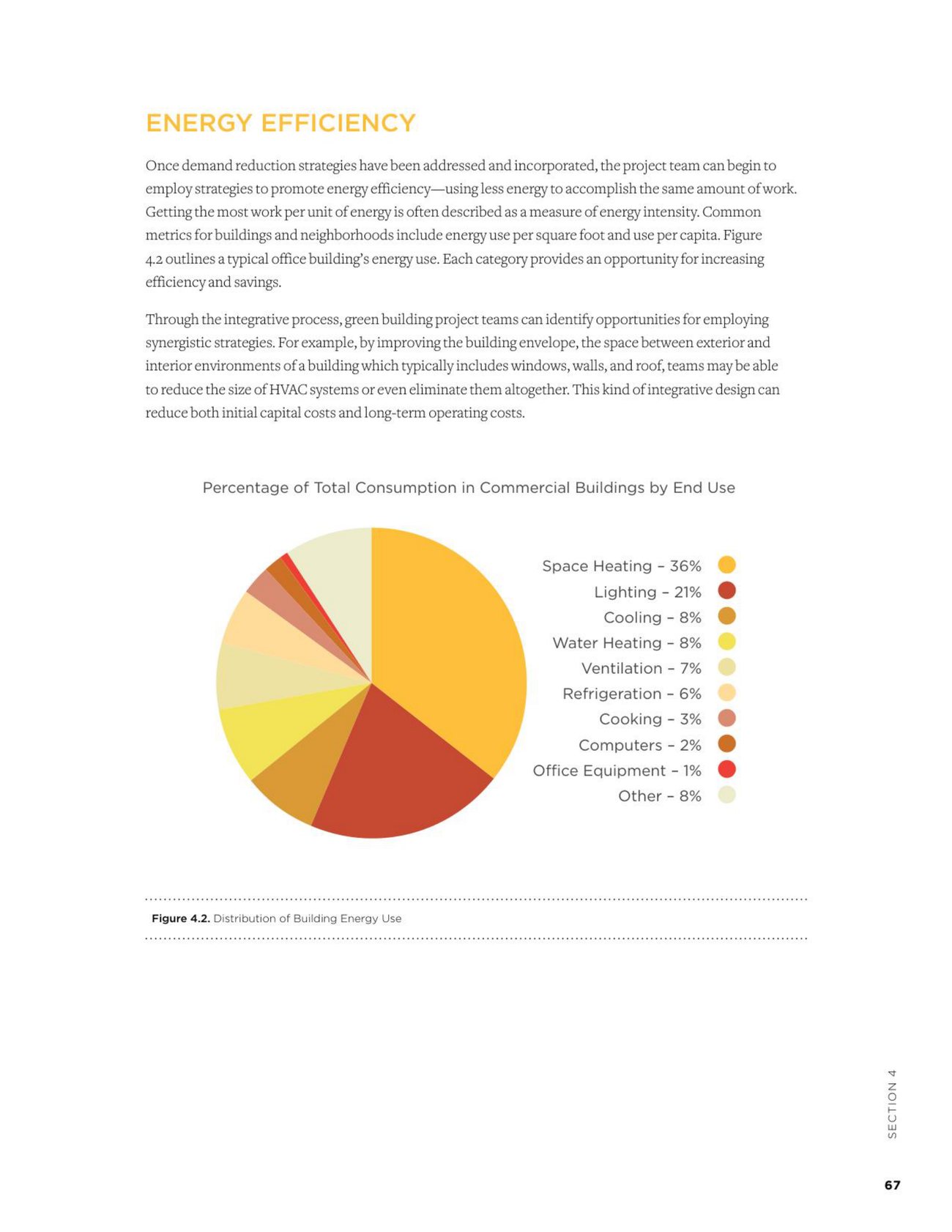
ENERGY EFFICIENCY Once demand reduction strategies have been addressed and incorporated, the project team can begin to employ strategies to promote energy efficiency—using less energy to accomplish the same amount of work. Getting the most work per unit of energy is often described as a measure of energy intensity. Common metrics for buildings and neighborhoods include energy use per square foot and use per capita. Figure 4.2 outlines a typical office building’s energy use. Each category provides an opportunity for increasing efficiency and savings. Through the integrative process, green building project teams can identify opportunities for employing synergistic strategies. For example, by improving the building envelope, the space between exterior and interior environments of a building which typically includes windows, walls, and roof, teams may be able to reduce the size of HVAC systems or even eliminate them altogether. This kind of integrative design can reduce both initial capital costs and long-term operating costs. Percentage of Total Consumption in Commercial Buildings by End Use Space Heating - 36% @ Lighting - 21% @ Cooling - 8% () Water Heating - 8% & Ventilation - 7% “— Refrigeration-6% Cooking - 3% @ Computers - 2% @ Office Equipment - 1% © Other - 8% Figure 4.2. Distribution of Building Energy Use v
So Ww un 67