ASHRAE-90.1-2022- - Page 005
Extracted Content
Mechanical
• Introduced an optional Mechanical System Performance Path that allows HVAC system efficiency trade- offs based on a new metric, total system performance ratio (TSPR).
• Required condensing boilers for new construction in order to achieve 90% or greater efficiency for large boilers (1 to 10 million Btuh. The thermal efficiency requirements for high-capacity gas-fired service water-heating equipment were also increased.
• Established a minimum enthalpy recovery ratio for energy recovery systems and specified operational requirements to ensure proper economized performance.
• Revised demand control ventilation requirements to be based on climate zone and Standard 62.1 airflow requirements.
• Modified the minimum efficiency requirements for air-source heat pumps and introduced a new metric, COPHR, for units that perform heat recovery during chiller operation.
• Added the minimum energy efficiency requirements (and new CFEI metric) for large-diameter ceiling fans from 10 CFR 430.
Performance Rating Method (Appendix G)
• New requirements were added to limit trade-offs between the building envelope and other building systems.
• A new Informative Appendix I was added that provides information on how alternative performance met- rics other than cost could be used with the Performance Rating Method. These alternative metrics include site energy, source energy, and carbon emissions, and would be useful to assess building performance against carbon emission goals or for similar types of comparison.
• A relaxation in stringency was added when using Normative Appendix G for retrofit projects consisting of substantial alterations.
Both Performance-Based Compliance Paths (Section 12 [Energy Cost Budget Method] and Appendix G)
• Numerous changes were included to improve clarity and coordinate with revisions to other sections of the standard.
New Normative Appendix J
• Contains performance curves that represent minimally compliant chiller performance for the budget and baseline building design and for proposed building designs when specific equipment performance is not known.
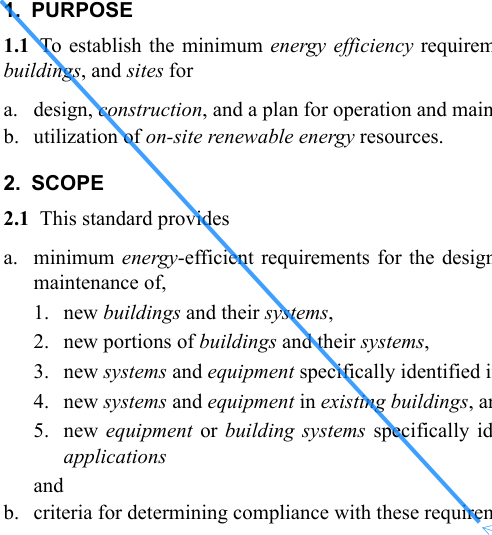
1. PURPOSE
1.1 To establish the minimum energy efficiency requirements of buildings other than low-rise residential buildings, and sites for
a. design, construction, and a plan for operation and maintenance; and b. utilization of on-site renewable energy resources.
2. SCOPE
2.1 This standard provides
a. minimum energy-efficient requirements for the design and construction, and a plan for operation and maintenance of,
- new buildings and their systems,
- new portions of buildings and their systems,
- new systems and equipment specifically identified in this standard that are part of a site,
- new systems and equipment in existing buildings, and
- new equipment or building systems specifically identified in this standard that are part of process applications
and
b. criteria for determining compliance with these requirements.
- PURPOSE + 2. SCOPE: NOT ADOPTED BY OREGON PER 2024 OEESC E102.3.2.
ANSI/ASHRAE/IES Standard 90.1-2022 (I-P) 3
THEREFORE 3 STORY MULTIFAMILY IS UNDER THIS CODE?
1