ASHRAE-90.1-2022- - Page 286
Extracted Content
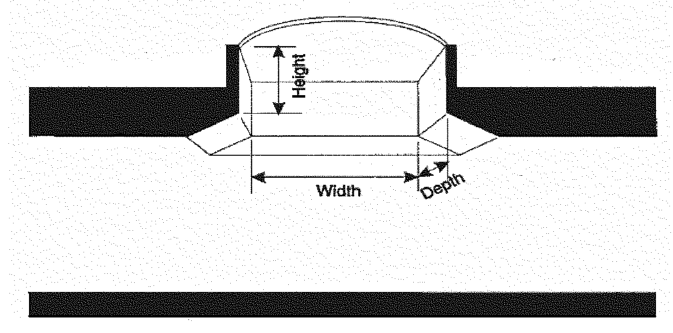
Figure C1.4 Skylight well dimensions.
C2.3 Location corresponding to the weather data used to perform the simulation.
C2.4 Simulation program used to perform the simulation.
C2.5 Tables summarizing the minimum information described in Section C1.
C2.6 All differences between the proposed envelope performance factor and the base envelope perfor- mance factor .
C2.7 Peak heating and cooling loads for building classes of constructions .
C2.8 The version of the software and the link to the website that contains the ASHRAE Standard 140 results for the version used in accordance with Section C3.1.4.
C2.9 For thermal bridges,
a. confirmation that the proposed design complies with the each of the requirements of Sections 5.5.5.1
through 5.5.5.5 including exceptions or b. where the proposed design does not comply with each of the individual requirements of Sections 5.5.5.1
through 5.5.5.5, list the thermal bridges, the proposed psi-factors, proposed chi-factors, and source information.
C3. SIMULATION GENERAL REQUIREMENTS
C3.1 Simulation Program. The simulation program shall be a computer-based software program for the analysis of energy consumption in buildings . The simulation program shall include calculation methodologies for the building components being modeled.
Informative Note: Examples of simulation programs include, but are not limited to, EnergyPlus and DOE-2.
C3.1.1 The simulation program shall be approved by the adopting authority and shall, at minimum, have the ability to explicitly model all of the following:
a. The base envelope performance factor, using only the input for the proposed envelope performance fac-
tor . The calculation procedure shall not allow the user to directly modify the building component characteristics of the base design. b. 8760 hours per year. c. Hourly variations in occupancy, lighting power, miscellaneous equipment power, thermostat set points,
and HVAC system operation, defined separately for each day of the week and holidays. d. Thermal mass effects. e. The number of thermal zones in the proposed design or nine thermal zones, whichever is greater. f. Air economizers with integrated control. g. Continuous daylight dimming controls and photosensors .
C3.1.2 The simulation program shall have the ability to determine the proposed envelope performance factor and base envelope performance factor by calculating annual energy costs.
Informative Note: Neither the proposed envelope performance factor nor the base envelope perfor- mance factor are predictions of actual energy consumption or costs for the proposed design after construc- tion . Actual experience will differ from these calculations due to variations such as occupancy, building
284 ANSI/ASHRAE/IES Standard 90.1-2022 (I-P)