ASHRAE-90.1-2022- - Page 313
Extracted Content
Table G3.1 Modeling Requirements for Calculating Proposed Building Performance and Baseline Building Performance (Continued)
| Proposed Building Performance | Baseline Building Performance |
|---|---|
| 10. HVAC Systems (continued) | |
d. Where no cooling system exists or no cooling system has been
submitted with design documents, the cooling system type shall be
the same as modeled in the baseline building design and shall
comply with the requirements of Section 6.
Exception: Spaces using baseline HVAC system types 9 and 10. | |
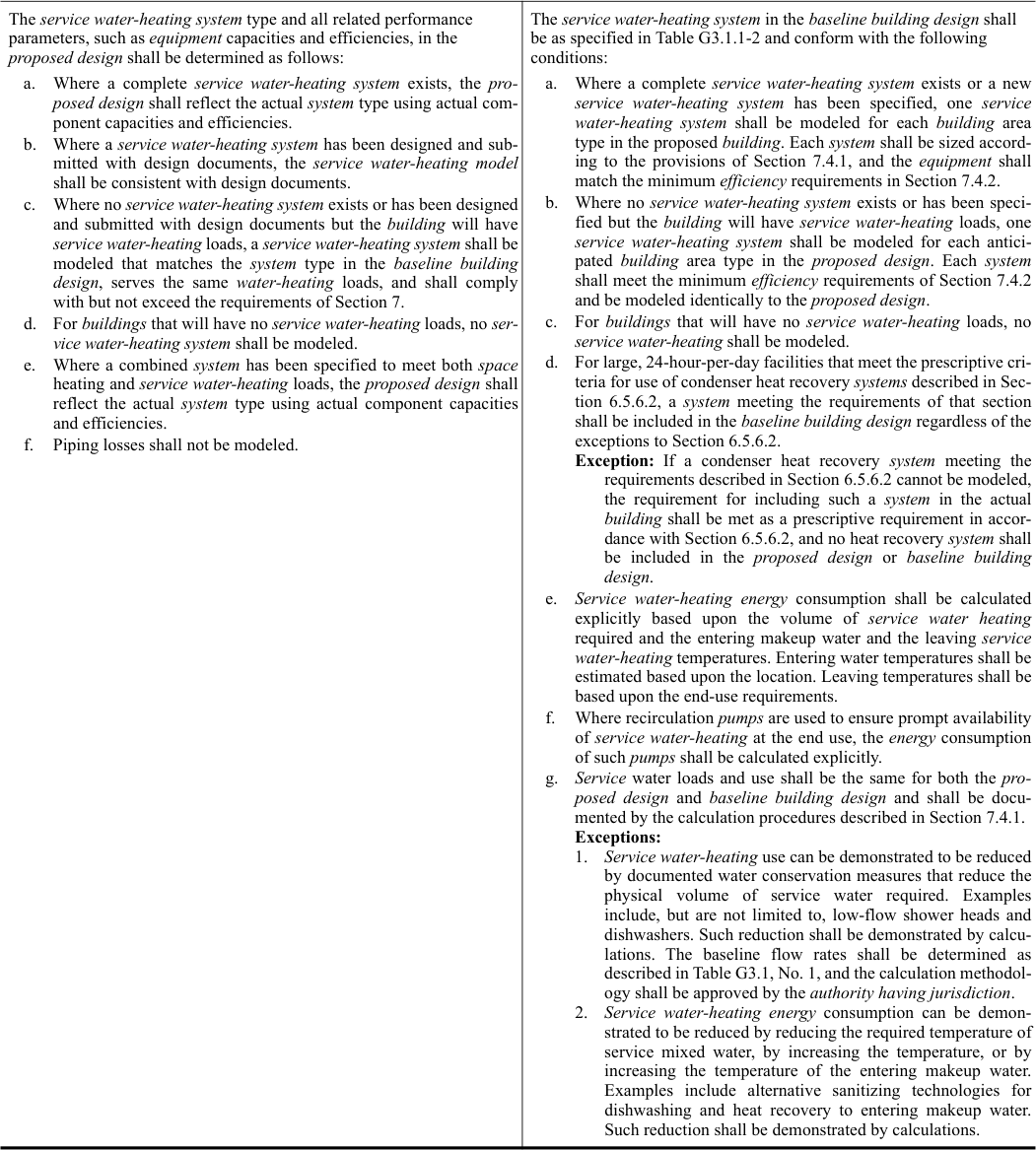
| 11. Service Water-Heating Systems | |
The service water-heating system type and all related performance
parameters, such as equipment capacities and efficiencies, in the
proposed design shall be determined as follows:
a. Where a complete service water-heating system exists, the pro-
posed design shall reflect the actual system type using actual com-
ponent capacities and efficiencies.
b. Where a service water-heating system has been designed and sub-
mitted with design documents, the service water-heating model
shall be consistent with design documents.
c. Where no service water-heating system exists or has been designed
and submitted with design documents but the building will have
service water-heating loads, a service water-heating system shall be
modeled that matches the system type in the baseline building
design, serves the same water-heating loads, and shall comply
with but not exceed the requirements of Section 7.
d. For buildings that will have no service water-heating loads, no ser-
vice water-heating system shall be modeled.
e. Where a combined system has been specified to meet both space
heating and service water-heating loads, the proposed design shall
reflect the actual system type using actual component capacities
and efficiencies.
f. Piping losses shall not be modeled. | The service water-heating system in the baseline building design shall
be as specified in Table G3.1.1-2 and conform with the following
conditions:
a. Where a complete service water-heating system exists or a new
service water-heating system has been specified, one service
water-heating system shall be modeled for each building area
type in the proposed building. Each system shall be sized accord-
ing to the provisions of Section 7.4.1, and the equipment shall
match the minimum efficiency requirements in Section 7.4.2.
b. Where no service water-heating system exists or has been speci-
fied but the building will have service water-heating loads, one
service water-heating system shall be modeled for each antici-
pated building area type in the proposed design. Each system
shall meet the minimum efficiency requirements of Section 7.4.2
and be modeled identically to the proposed design.
c. For buildings that will have no service water-heating loads, no
service water-heating shall be modeled.
d. For large, 24-hour-per-day facilities that meet the prescriptive cri-
teria for use of condenser heat recovery systems described in Sec-
tion 6.5.6.2, a system meeting the requirements of that section
shall be included in the baseline building design regardless of the
exceptions to Section 6.5.6.2.
Exception: If a condenser heat recovery system meeting the
requirements described in Section 6.5.6.2 cannot be modeled,
the requirement for including such a system in the actual
building shall be met as a prescriptive requirement in accor-
dance with Section 6.5.6.2, and no heat recovery system shall
be included in the proposed design or baseline building
design.
e. Service water-heating energy consumption shall be calculated
explicitly based upon the volume of service water heating
required and the entering makeup water and the leaving service
water-heating temperatures. Entering water temperatures shall be
estimated based upon the location. Leaving temperatures shall be
based upon the end-use requirements.
f. Where recirculation pumps are used to ensure prompt availability
of service water-heating at the end use, the energy consumption
of such pumps shall be calculated explicitly.
g. Service water loads and use shall be the same for both the pro-
posed design and baseline building design and shall be docu-
mented by the calculation procedures described in Section 7.4.1.
Exceptions:
1. Service water-heating use can be demonstrated to be reduced
by documented water conservation measures that reduce the
physical volume of service water required. Examples
include, but are not limited to, low-flow shower heads and
dishwashers. Such reduction shall be demonstrated by calcu-
lations. The baseline flow rates shall be determined as
described in Table G3.1, No. 1, and the calculation methodol-
ogy shall be approved by the authority having jurisdiction.
2. Service water-heating energy consumption can be demon-
strated to be reduced by reducing the required temperature of
service mixed water, by increasing the temperature, or by
increasing the temperature of the entering makeup water.
Examples include alternative sanitizing technologies for
dishwashing and heat recovery to entering makeup water.
Such reduction shall be demonstrated by calculations. |

ANSI/ASHRAE/IES Standard 90.1-2022 (I-P) 311