ASHRAE-Standard-55 - Page 012
Extracted Content
Table 5-4 Added Insulation when Sitting on a Chair (Applicable to Clothing Ensembles with Standing Insulation Values of 0.5 clo < Icl < 1.2 clo)
| Net chair a | 0.00 clo |
|---|---|
| Metal chair | 0.00 clo |
| Wooden side-arm chair b | 0.00 clo |
| Wooden stool | +0.01 clo |
| Standard office chair | +0.10 clo |
| Executive chair | +0.15 clo |
a. A chair constructed from thin, widely spaced cords that provide no thermal insulation. b. Informative Note: This chair was used in most of the basic studies of thermal comfort that were used to establish the PMV-PPD index.
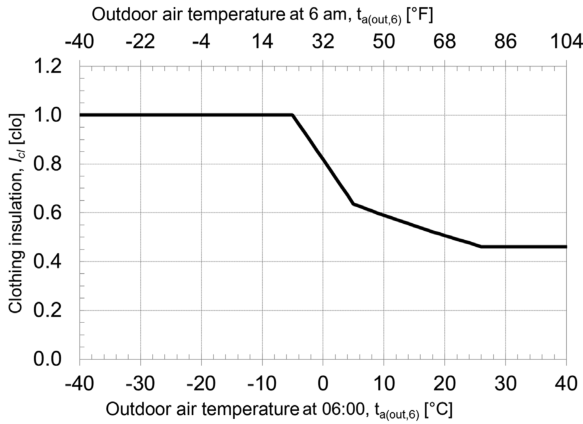
Figure 5-1 Representative clothing insulation Icl as a function of outdoor air temperature at 06:00 a.m.
- The space has air temperature stratification that meets the requirements of Section 5.3.5.3.
- The space does not have active radiant surfaces.
- Building envelope opaque surfaces of the space (walls, floor, roof) meet U-factor prescriptive requirement of ASHRAE/IES Standard 90.1 [ 2] .
- Outdoor air temperature is less than 43°C (110°F).
- Vertical fenestration has less than 9 ft (3 m) of total height.
- No skylights are present.
- The space complies with all requirements in a single row of Table 5-5, 5-6, 5-7, or 5-8. Interpolation between values within a single table (Table 5-5, 5-6, 5-7, or 5-8), but not between tables, is permissible. Solar absorptance properties for shade fabrics used in Table 5-5, 5-6, 5-7, or 5-8 shall use the most similar color from Table 5-9 unless more specific data are available from the manufacturer.
Table 5-5, 5-6, 5-7, or 5-8 show criteria that allow use of mean radiant temperature tr that is 2.8°C (5°F) higher than average air temperature ta for high-performance glazing units (Table 5-5); clear, low-performance glazing units (Table 5-6); tinted glazing units (Table 5-7); and dynamic glazing units (Table 5-8). See Normative Appendix C, Section C2(e) for a description of fbes .
5.3.4 Elevated Air Speed Adjustment. For air speeds above 0.1 m/s (20 fpm), the standard effective temperature (SET) model is used in conjunction with the PMV model as described in Normative Appendix D.
Figure 5-4 represents two particular cases (0.5 and 1.0 clo) of the comfort zone across the range of indoor air speeds, and shall be permitted as a method of compliance for the conditions specified in the figure. The figure also defines comfort zones for air movement with occupant control (darkly shaded; Section 5.3.4.1) versus without occupant control (lightly shaded; Section 5.3.4.2). It is permissible to determine the operative temperature range by linear interpolation between the limits found for each zone in Figure 5-4.
10 ANSI/ASHRAE Standard 55-2023