ASHRAE-Standard-55 - Page 018
Extracted Content
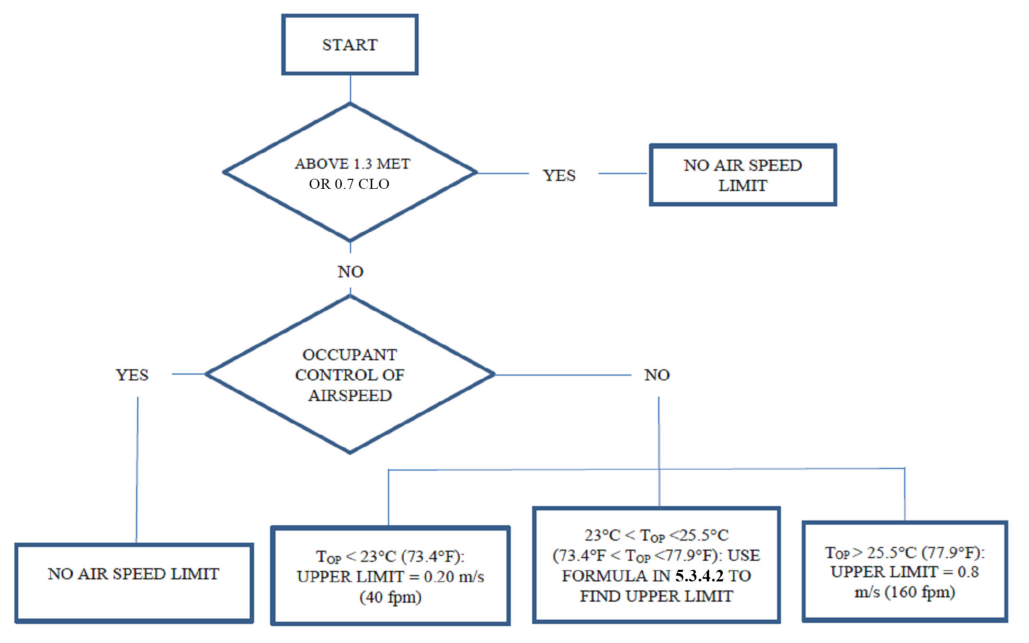
Figure 5-6 Flowchart for determining limits to air speed inputs in the elevated air speed comfort zone.
5.3.5 Local Thermal Discomfort 5.3.5.1 Applicability. The requirements specified in this section are required to be met only when representative occupants meet both of the following criteria:
a. Have clothing insulation Icl less than 0.7 clo b. Are engaged in physical activity with metabolic rates below 1.3 met
For the purpose of compliance with this section, representative occupants’ ankle level is 0.1 m (4 in.) above the floor, and head level is 1.1 m (43 in.) for seated occupants and 1.7 m (67 in.) for standing occupants. Informative Note: The standard does not contain requirements for standing occupants when all the repre sentative occupants are seated. Many standing occupants have met rates greater than 1.3 (see Section 5.2.1), and by criterion (b) above, the requirements of Section 5.3.5 do not apply to them. 5.3.5.2 Radiant Temperature Asymmetry. Radiant temperature asymmetry shall not exceed the values in Table 5-10. The radiant temperature asymmetry is quantified in its definition in Section 3.
When direct-beam solar radiation falls on a representative occupant, the radiant temperature asymmetry shall include the solar contribution as follows: The short-wave mean radiant temperature trsw, as determined in Normative Appendix C, shall be multiplied by two and added to the plane radiant temperature tpr for each horizontal or vertical direction in which the plane receives direct sunlight.
5.3.5.3 Ankle Air Speed. Air speed at 0.1 m (4 in.) above the floor shall be less than the value resulting from the following formula or in the shaded region of Figure 5-7:
Vankle < 0.35TS + 0.39 ( Vankle in m/s)
Vankle < 70.7TS + 79.6 ( Vankle in fpm)
where Vankle = air speed at 0.1 m (4 in.) above the floor TS = whole-body thermal sensation; equal to PMV calculated using the input air temperature and speed
16 ANSI/ASHRAE Standard 55-2023