ASHRAE-Standard-55 - Page 019
Extracted Content
Table 5-10 Allowable Radiant Temperature Asymmetry
Radiant Temperature Asymmetry °C (°F)
| Ceiling Warmer than Floor | Ceiling Cooler than Floor | Wall Warmer than Air | Wall Cooler than Air |
|---|---|---|---|
| <5 (9.0) | <14 (25.2) | <23 (41.4) | <10 (18.0) |
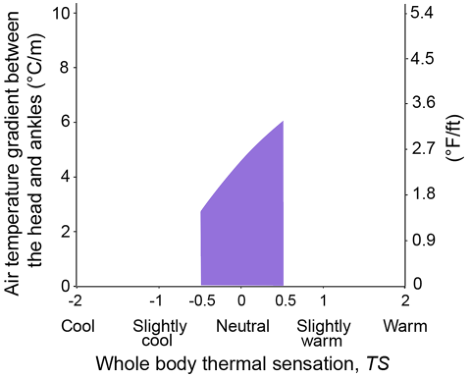
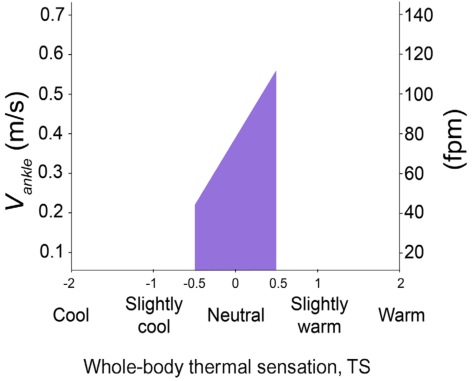
Figure 5-7 Air speed limits at 0.1 m (4 in.) above the floor as Figure 5-8 Vertical air temperature gradient limit as a func- a function of whole-body thermal sensation. tion of whole-body thermal sensation.
averaged over two heights: 0.6 m (24 in.) and 1.1 m (43 in.) for seated occupants and 1.1 m (43 in.) and 1.7 m (67 in.) for standing occupants Exception to 5.3.5.3: The requirement in this section does not apply when using elevated air speed in Sec tion 5.3.4. 5.3.5.4 Vertical Air Temperature Gradient. Air temperature gradient between head level and ankle level shall not exceed the value resulting from the following formula or in the shaded region of Figure 5-8.
T 7.82 - 0.87 TS - 1.91 [2] T in °C/m
T 4.29 - 0.48 TS - 1.91 [2] T in °F/ft
where
T = air temperature gradient between head and ankles, °C/m (°F/ft)
TS = whole-body thermal sensation. This is equal to the PMV calculated using the input air temperatures over two heights: 0.6 m (24 in.) and 1.1 m (43 in.) for seated occupants and 1.1 m (43 in.) and 1.7 m (67 in.) for standing occupants. Exception to 5.3.5.4: The requirement in this section does not apply when using elevated air speed in Sec tion 5.3.4. Informative Note: Refer to the informative note in Section 5.3.5.1.
5.3.5.5 Floor Surface Temperature. When representative occupants are seated with feet in contact with the floor, floor surface temperatures within the occupied zone shall be 19°C to 29°C (66.2°F to 84.2°F).
5.3.6 Temperature Variations with Time 5.3.6.1 Applicability. The fluctuation requirements of this section shall be met when they are not under the direct control of the individual occupant.
5.3.6.2 Cyclic Variations. Cyclic variations in operative temperature to that have a period not greater than 15 minutes shall have a peak-to-peak amplitude not greater than 1.1°C (2.0°F).
5.3.6.3 Drifts or Ramps. Monotonic, noncyclic changes in operative temperature to and cyclic variations with a period greater than 15 minutes shall not exceed the most restrictive requirements from Table 5-11. Informative Note: For example, the operative temperature shall not change more than 2.2°C (4.0°F) during
a 1.0 hour period and more than 1.1°C (2.0°F) during any 0.25 hour period within that 1.0 hour period.
ANSI/ASHRAE Standard 55-2023 17