ASHRAE-Standard-55 - Page 054
Extracted Content
where PPD AD = predicted percentage of dissatisfied with ankle draft, % TS = whole-body thermal sensation; equal to PMV calculated using the input air temperature and speed averaged over two heights: 0.6 m (24 in.) and 1.1 m (43 in.) for seated occupants and 1.1 m (43 in.) and 1.7 m (67 in.) for standing occupants Vankle = air speed at the 0.1 m (4 in.) above the floor
The air speed limits at 0.1 m (4 in.) in Section 5.3.5.3 are derived by setting PPD AD equal to 20%. The PPD AD provides a simple tool to estimate the draft at ankles and lower legs. In this model, the whole-body thermal sensation can be approximated using the PMV with the input air temperature and speed averaged over two heights and not three as in the rest of the standard. The two heights are 0.6 m (24 in.) and 1.1 m (43 in.) for seated occupants and 1.1 m (43 in.) and 1.7 m (67 in.) for standing occupants.
I4. VERTICAL AIR TEMPERATURE DIFFERENCE
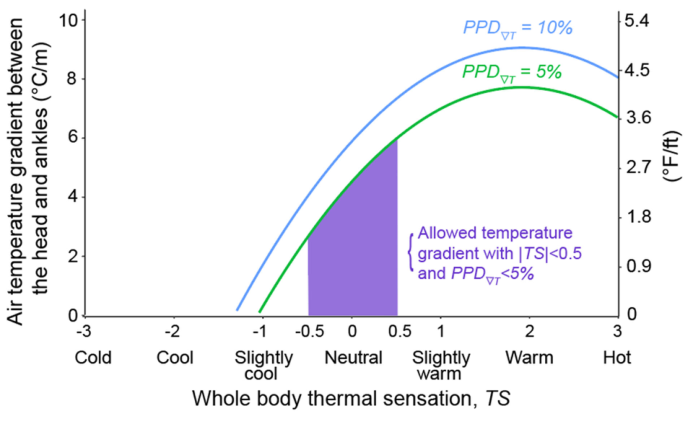
Thermal stratification that results in the air temperature at the head level being warmer than that at the ankle level may cause thermal discomfort. Section 5.3.5.4 of this standard specifies allowable gradients of the air temperature between head level and ankle level. The maximum air temperature gradient is deduced from the predicted percentage dissatisfied with vertical air temperature gradient ( PPD ∇T). PPD ∇T is an index that establishes a quantitative prediction of the percentage of thermally dissatisfied people with air temperature gradient. PPD ∇T is calculated according to the following formula deduced from Figure I-3.
PPD T
PPD T
e [0.13] [TS] - 1.91 [2] + 0.15 T - 1.6
= -------------------------------------------------------------------- - 34.5% T in °C/m 1 + e [0.13] [TS] - 1.91 [2] + 0.15 T - 1.6
0.55 e [0.13] [TS] - 1.91 [2] + 0.083 T - 1.6
= ---------------------------------------------------------------------- - - 34.5% T in °F/ft 1 + e [0.13] [TS] - 1.91 [2] + 0.083 T - 1.6
where
PPD T
PPD T = predicted percentage dissatisfied with vertical air temperature gradient for local discomfort, %.
PPD ∇T is 0% if a negative value is calculated. TS = whole-body thermal sensation. This is equal to the PMV calculated using the input air temperatures over two heights: 0.6 m (24 in.) and 1.1 m (43 in.) for seated occupants and 1.1 m (43 in.) and 1.7 m (67 in.) for standing occupants.
T = air temperature gradient between the head and ankles, °C/m (°F/ft)
T
The vertical air temperature gradient limits in Section 5.3.5.4 are derived by setting PPD T equal to 5%. Figure I-3 shows the expected percentage of occupants who are dissatisfied due to the air temperature
Figure I-3 Vertical air temperature gradient limit between the head and ankles as a function of whole body thermal sensation and the predicted percentage dissatisfied with vertical air temperature gradient (PPD ∇ T ).
52 ANSI/ASHRAE Standard 55-2023