ASHRAE-Standard-55 - Page 055
Extracted Content
difference where the head level is warmer than the ankle level. Thermal stratification in the opposite direction is rare, is perceived more favorably by occupants, and is not addressed in this standard.
The allowable difference in air temperature from ankle level to head level is based on Figure I-3 and assumes that a maximum of 5% of occupants are dissatisfied by the vertical air stratification.
I5. FLOOR SURFACE TEMPERATURE
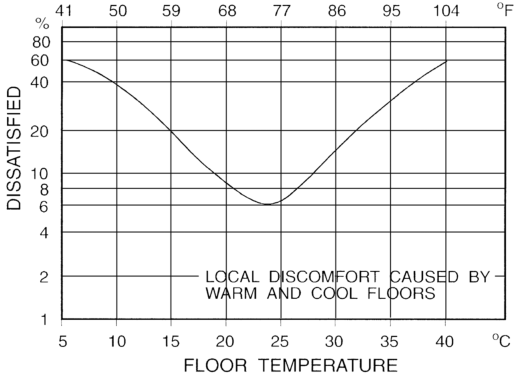
Occupants may feel uncomfortable due to contact with floor surfaces that are too warm or too cool. The temperature of the floor, rather than the material of the floor covering, is the most important factor for foot thermal comfort while wearing shoes. Figure I-4 gives the percentage of occupants expected to be dissatisfied due to floor temperature tf based on people wearing lightweight indoor shoes. Thus, it is acceptable to use these criteria for people wearing heavier footgear, as they will be conservative. This standard does not address the floor temperature required for people not wearing shoes, nor does it address satisfactory floor temperatures for people sitting on the floor.
The limit for floor temperature tf is based on Figure I-4 and assumes that a maximum of 10% of occupants are dissatisfied by warm or cold floors.
I6. TEMPERATURE VARIATIONS WITH TIME
Fluctuations in the air temperature and/or mean radiant temperature tr may affect the thermal comfort of occupants. Those fluctuations under the direct control of the individual occupant do not have a negative impact on thermal comfort, and the requirements of this standard do not apply to these fluctuations. Fluctuations that occur due to factors not under the direct control of the individual occupant (e.g., cycling from thermostatic control) may have a negative effect on comfort, and the requirements of this standard apply to these fluctuations. Fluctuations that occupants experience as a result of moving between locations with different environmental conditions are allowed by Section 5 of this standard as long as the conditions at all of these locations are within the comfort zone for these moving occupants.
I7. CYCLIC VARIATIONS
Cyclic variations refer to those situations where the operative temperature to repeatedly rises and falls and the period of these variations is not greater than 15 minutes. If the period of the fluctuation cycle exceeds 15 minutes, the variation is treated as a drift or ramp in operative temperature, and the requirements of Section 5.3.6.3 apply. In some situations, variations with a period not greater than 15 minutes are superimposed on variations with a longer period. In these situations, the requirements of Section 5.3.6.3 apply to the component of the variation with a period not greater than 15 minutes, and the requirements of Section 5.3.6.3 apply to the component of the variation with a period greater than 15 minutes.
I8. DRIFTS OR RAMPS
Temperature drifts and ramps are monotonic, noncyclic changes in operative temperature to . The requirements of Section 5.3.6.3 also apply to cyclic variations with a period greater than 15 minutes. Generally, “drifts” refer to passive temperature changes of the enclosed space, and “ramps” refer to actively controlled temperature changes.
Figure I-4 Local discomfort caused by warm and cool floors.
ANSI/ASHRAE Standard 55-2023 53